FOR VIEWING LINKS, PLEASE CONTACT LUZIE[AT]LUZIEMEYER.NET, SWEETWATER BERLIN, OR FANTA-MLN, MILAN.
Voire Dire (2024)
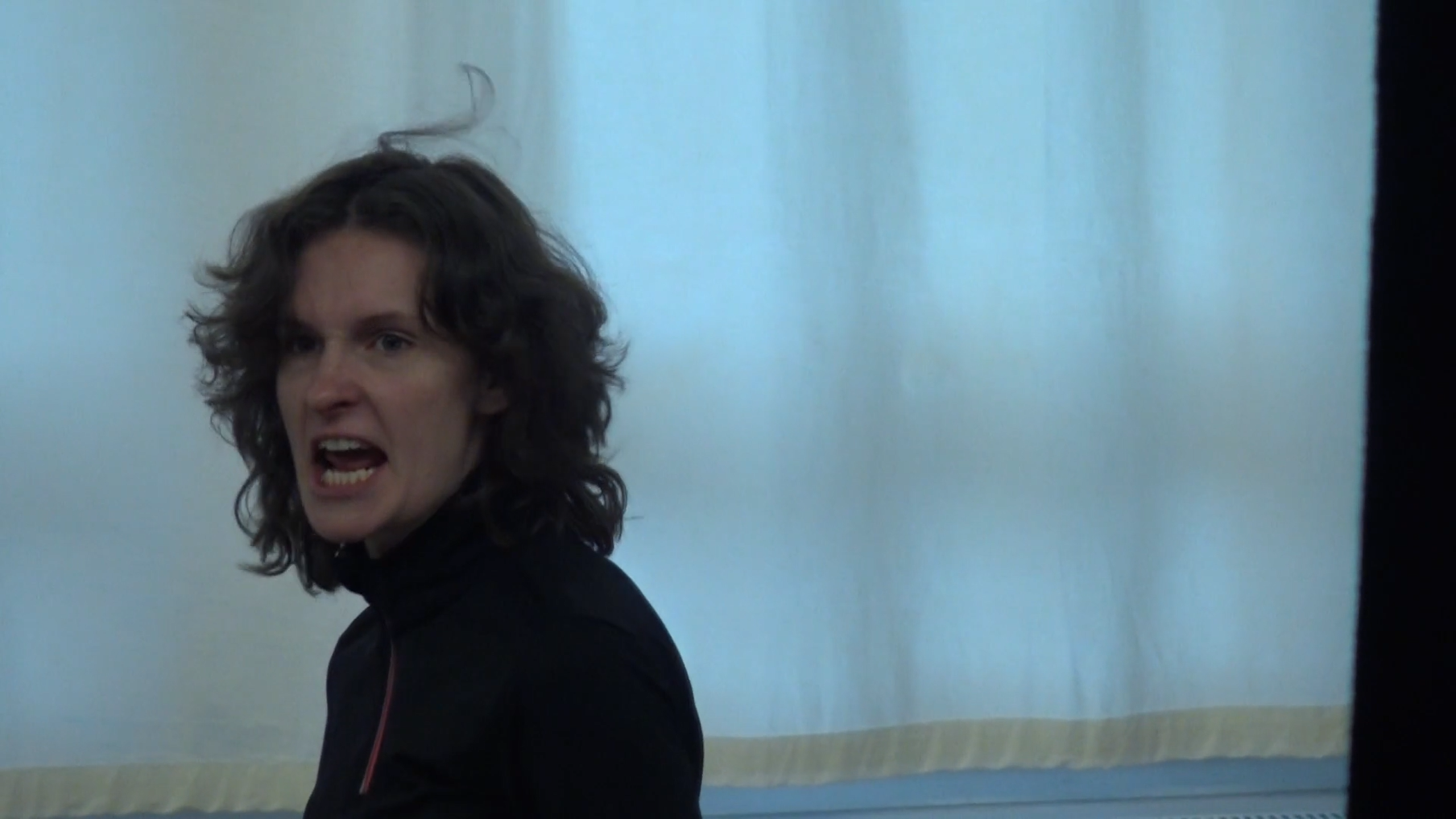
21 minutes, 7 seconds. In Voir Dire (2024), Luzie Meyer invites actor Maria Lehberg to rehearse and reenact a pivotal courtroom scene from …And Justice For All (1979) inside a real Berlin district court, replacing Al Pacino’s male defense lawyer with a female-reading performer. By repeatedly rehearsing the monologue in varying emotional registers, the piece subverts the original power dynamics and provokes emotional dissonance, generating a sense of alienation. Blending improvisation, German-language elements, and documentary fragments, the video interrogates the interplay between emotional bias, moral judgment, and legal rhetoric, placing viewers in a charged space between voyeurism and address, and highlighting the fraught tension between individual rights and institutional violence.
Gaze Still (2023)
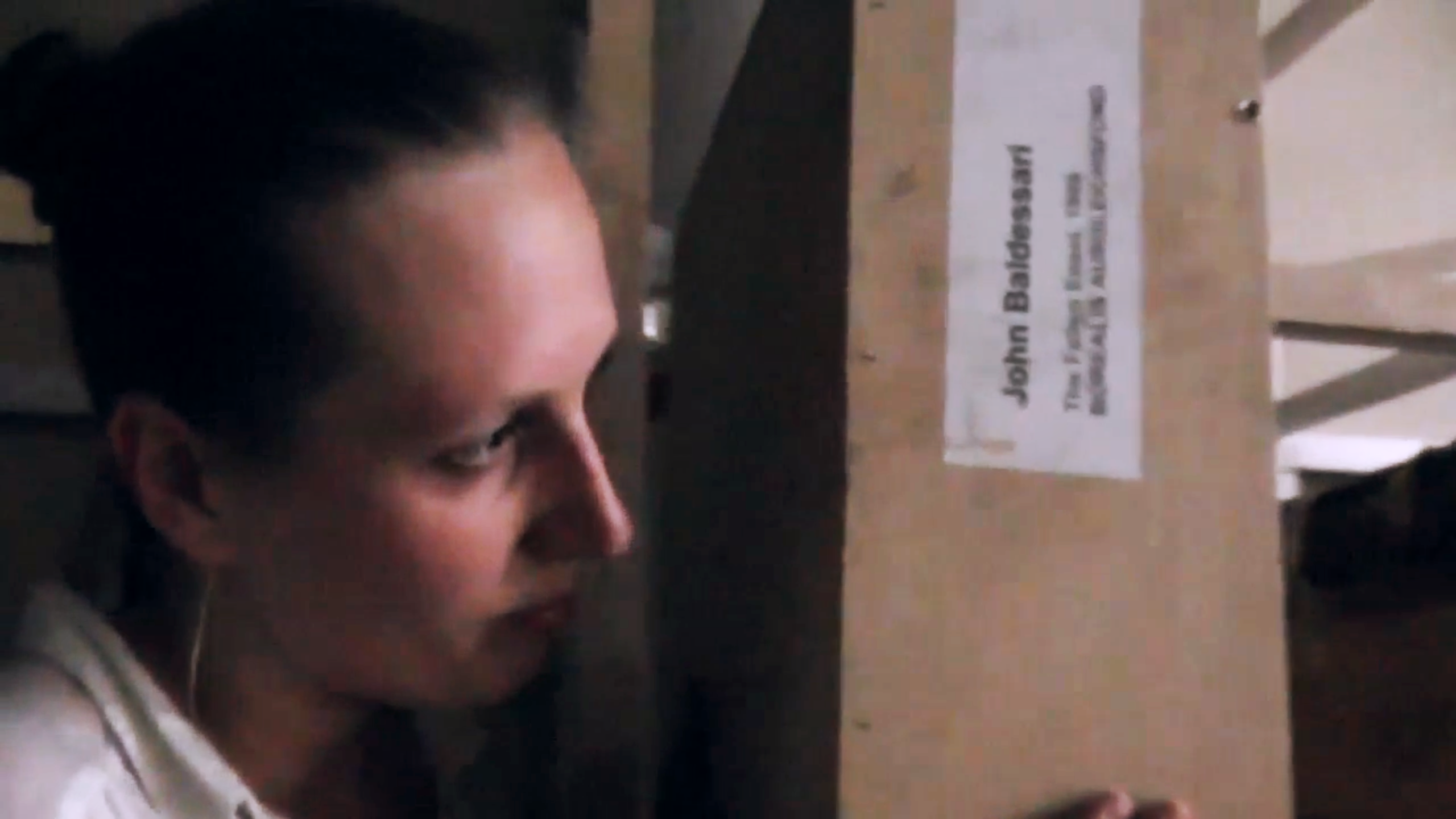
Created within the Institute for Scene Experiments (ISE), initiated by artist Nikhil Vettukattil, this piece emerged from an 8-hour workshop at KW Institute for Contemporary Art Berlin, where a Chantal Akerman-inspired kitchen scene was repeatedly re-enacted and filmed from shifting angles, and variations in lighting, direction, and roles. Various individual edits of the collective material were later shown in the Studiengalerie 1.357 in Frankfurt am Main (2023), in collaboration with the Fassbinder Archive. Set to John Dowland’s Time Stands Still and with altered video speed, the piece explores iconography, temporality, and emotional resonance through focused attention and its disruption. Part of The Institute for Scene Experiments - Postproduction at Studiengalerie Goethe-University, Frankfurt.
Cyclic Indirections (2022)
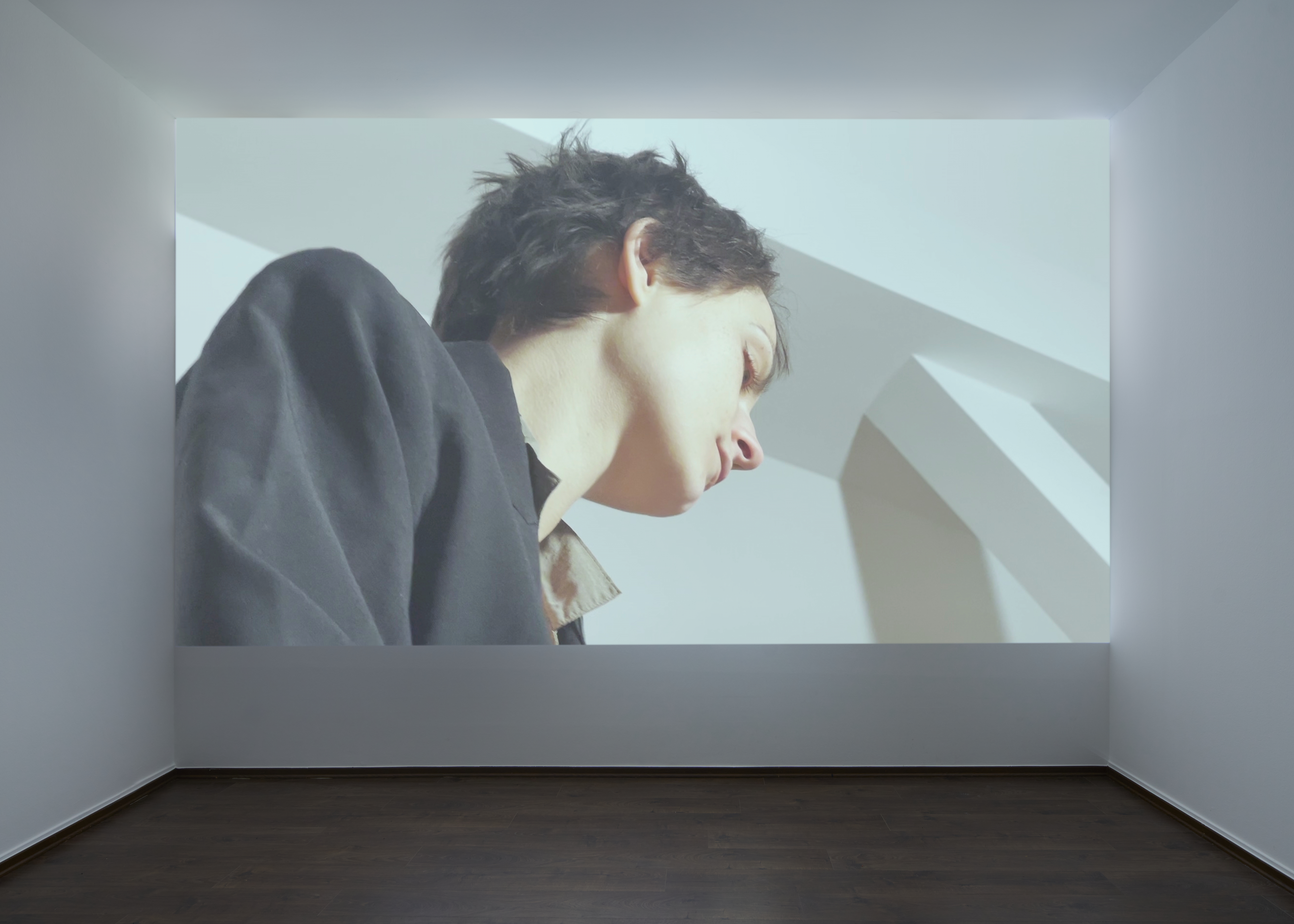
The work was developed in response to the encounter with the Simon-Loschen-Lighthouse and the coincidental reading of Sara Ahmed’s Queer Phenomenology. Departing from the lighthouse’s function as orientation device, which interpellates individuals and regulates societal alignment, the artist framed the building as a phallic symbol of subjectivation. Meyer’s fictionalized ascension of the lighthouse staircase includes both first- and second person camera perspectives. Using sharp, swift montage, a bilingual (EN-DE) voiceover, and an original musical soundtrack, the filmed material was composed into a broken meta-narrative about the process of identifying, infiltrating, and sabotaging internalized societal norms. The video’s increasing brightness and color are counteracted by and increase of black- outs and flickers as the suspense rises. The voiceover features the artist’s own voice, as well as that of the Kunsthalle’s director Stefanie Kleefeld, and contains intentional mistranslations and self-reflexive formal elements. The piece includes references to Marcel Duchamp’s Nude Descending a Staircase, Chantal Akerman’s Hotel Monterey and La Chambre, and allusions to Homer’s Odyssey.
Lasciatemi Morire (2021)
Marta Abba and Cathy Berberian meet on stage. Their biographies are fictionalized, interweaved with received ideas and a repertoire of clichéed projections of the self.Their characters, entangled, oscillate in a continuous dialectic between the individual and the universal,
the authentic and the constructed. Death is hovering above them. Invoked, rehearsed, mourned, deferred, it fails to deliver its romantic promise of redemption. With Dalia Maini. Filmed at KW, Berlin.
Incognito Ergo Non Sum, 2020 (2020)
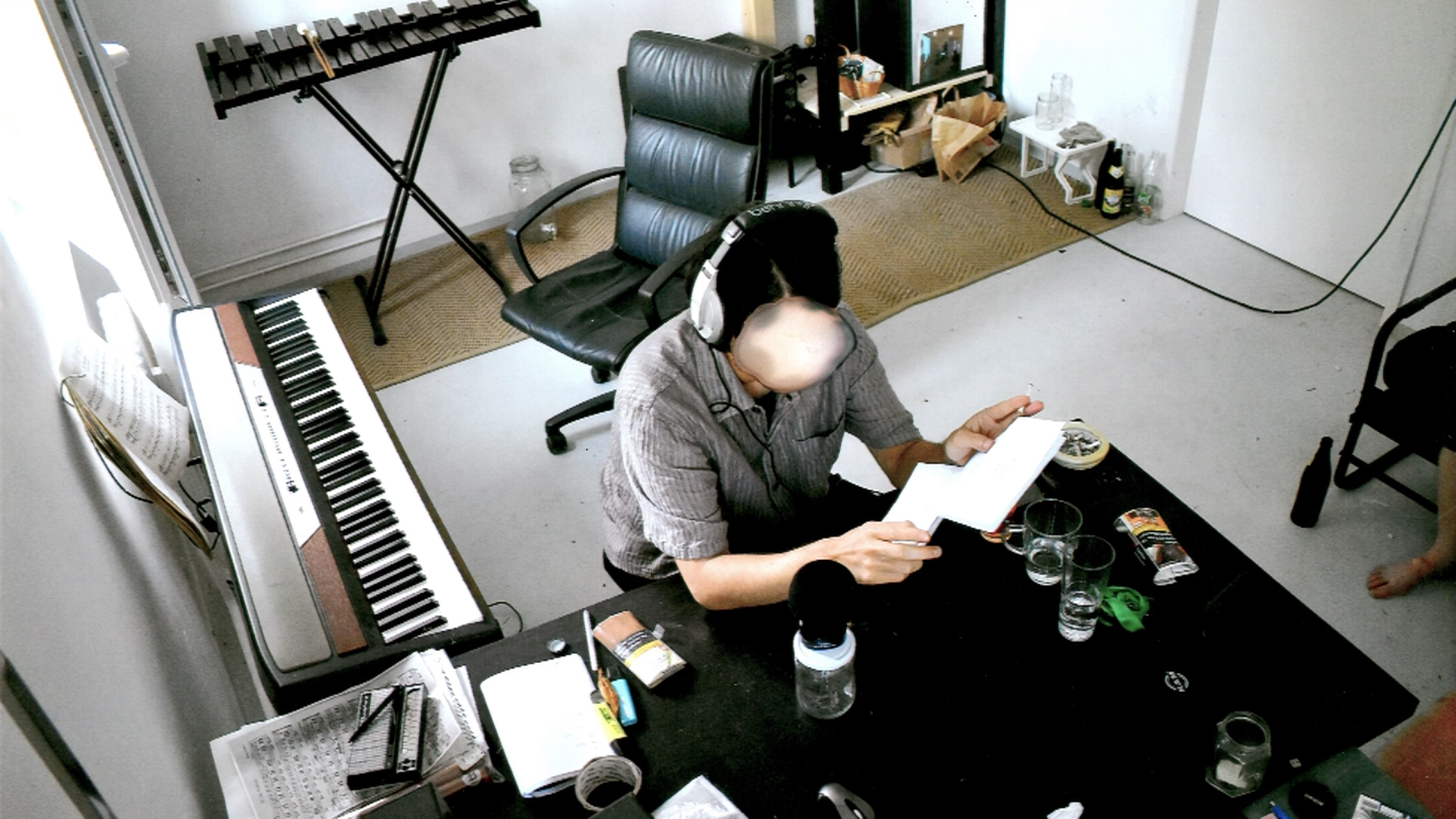
This film was specifically made for LISTE art fair's online iteration during the COVID-19 pandemic. It is the bizarre staging of a conversation between an artist and a galerist. Two actors were photographed during the rehearsal for the recording of a scripted dialogue which is heard in the background soundtrack. The photographs were manipulated with acetone to conceal the actors' identities.
A pseudo-neoclassical piano accompaniment drives the rhythm of the dialogue as it evolves into a theater of absurdity. It deals with the characters' public, professional and private lives, containing their strategies of personal image management, their choices and values.
The script is based on personal experiences and observations from the art world, which are scattered amongst fictionalizations
and exaggerations.
SIMULTAN / duplicitous consent (2019)
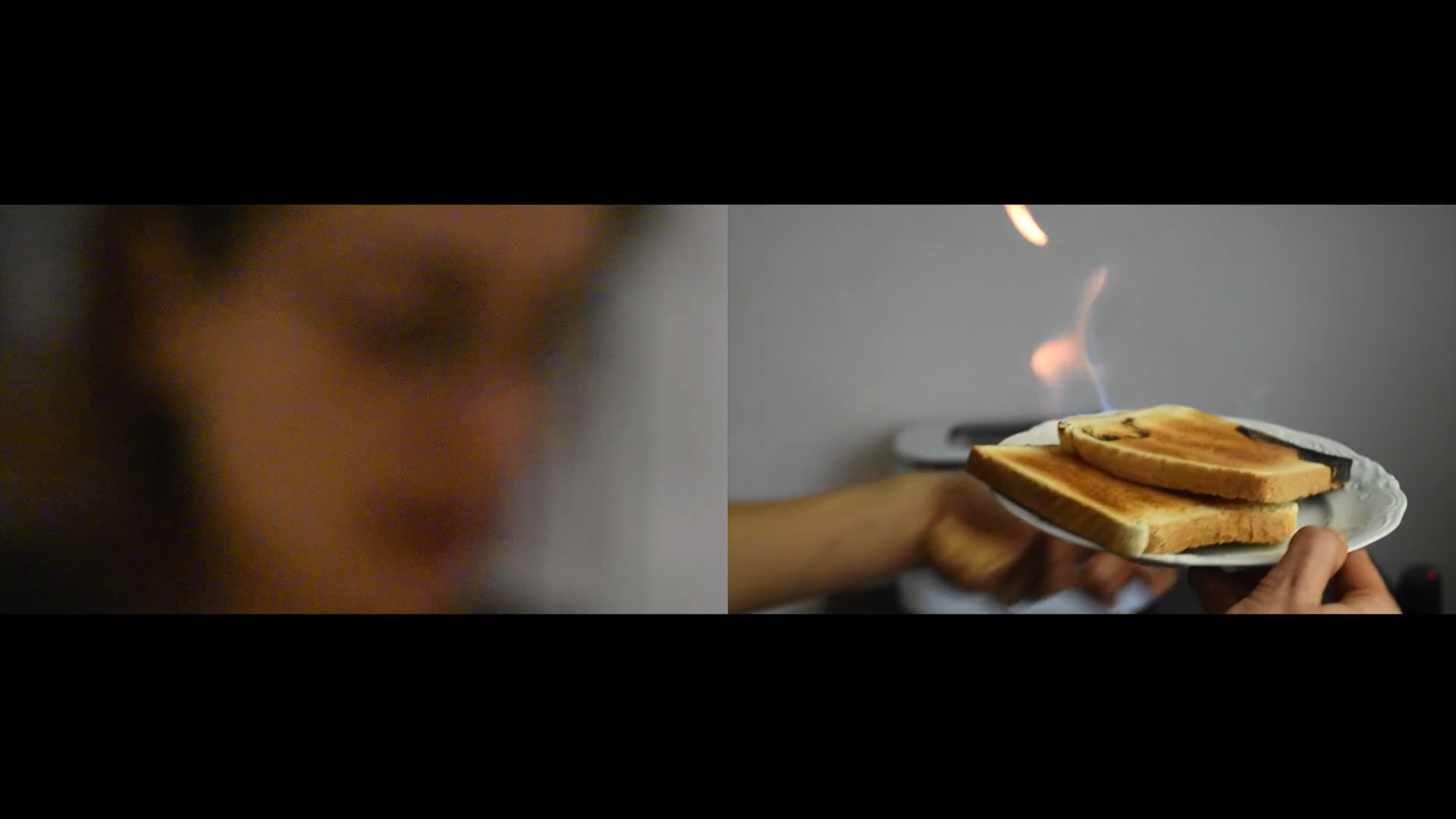
12 minutes, 59 seconds. The bilingual video SIMULTAN was part of Duplicitous Consent, a 2019 solo exhibition at Sweetwater, Berlin. It is based on a short story by Ingeborg Bachmann, about a translator who loses the emotional connection to herself within multiple languages. SIMULTAN explores alienation, the loss of belonging, and the inadequacy of words to account for psychological suffering. Two kitchens served as sets for respectively two female* actors, each of whom recites a stream-of- consciousness text, one in English, one in German. The two actors and the artist all appear in the video, but as all three are dressed alike, it becomes difficult to differentiate between them. The footage is mostly blurry and abstract, but interspersed are short moments in focus. The sounds of singing voices, the scraping on burnt pieces of toast, or resonating wine glasses were assembled into a musical composition, in which rhythm and melody supersede words, creating a visceral, disorienting, frantic atmosphere. As fast pace neurotic chatter is replaced with mournful absurdities and interspersed with melodies, the double screen (2 x 16:9) materially illustrates a spliting or a fragmentation of the self.
. With Beth Collar and Laura Ziegler.
The Trout (2019)
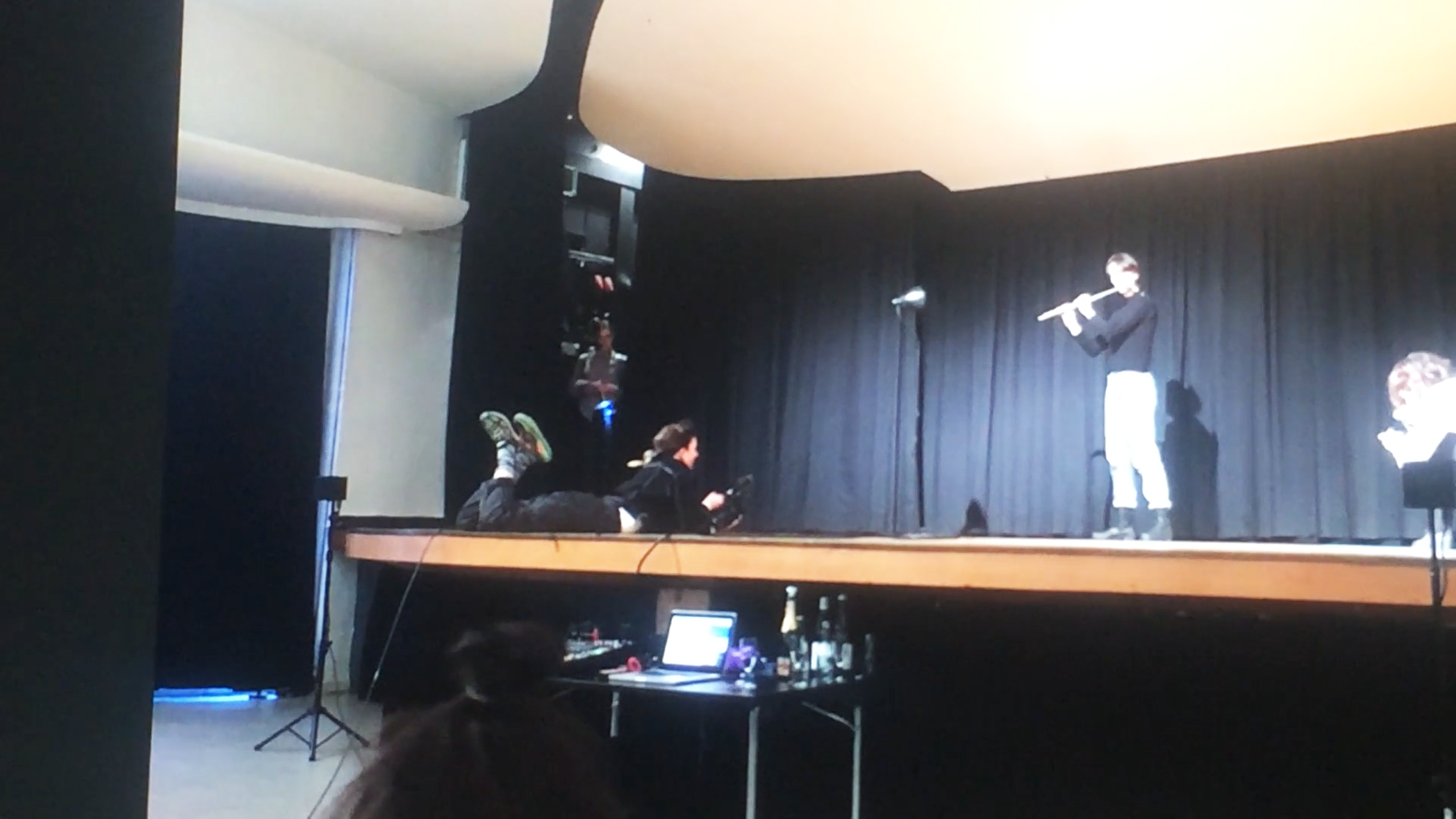
Metapiece on The FLute. Schubert's song The Trout and audience photographs are used to explore the captivating power of performance documentation.
The Flute (2018)
The Flute was staged at the Kunstverein in Cologne, both as a performance and film shoot. Four performers, including the artist, performed both as their “real” selves and as and fictional characters: Souffleuse, Narrator, Flutist and Cameraperson. The performers followed a script spanning five acts. Each of the five acts was accompanied by a different, originally composed beat, that the flutist improvised to. At the same time, the performers captured the performance with two cameras, which were passed around between them. The footage was live-projected on two screens in the same space. In this way, the audience was given the choice whether to follow the live performance or the mediated “video- livestream” and had the opportunity to become aware of their role as spectators. The cut-up script was based on research on the anthropology and mythology of the flute, whose sound is in many cultures constructed as a site of desire and of power struggles around gender. Both original writing and appropriated material were used for the script. Performers: Emma LaMorte - Camerawoman, Lisa Gutscher - Souffleuse, Theresa Patzschke - Flutist, Luzie Meyer - Narrator.
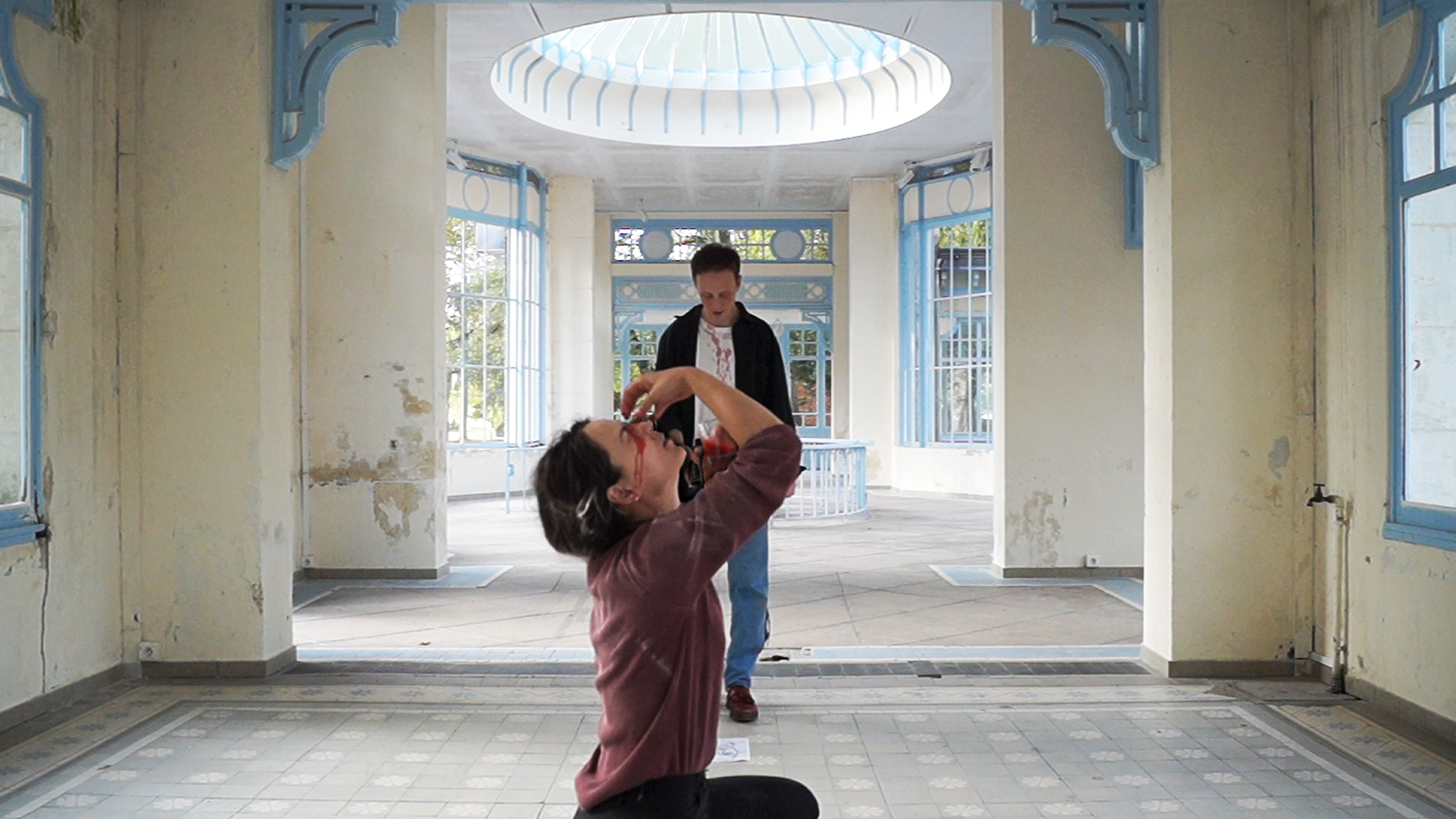
St. Lucy or To Look Upon Men with Lust (2017)
Filmed in Pougues-Les-Eaux, France.
The Balcony (2016)
Meyer's first solo video work. Based on Jean Genet's The Balcony. Filmed at an old amphitheatre near Basel. With Reece York, Salomo Andrèn, Dan Kwon.
Guerilla Videos I & II (2012)
Collaborative work by Rose Beermann and Luzie Meyer. Filmed during the exhibition Moments - A History of Performance Art in 10 Acts.


.png)
.png)
.png)
.png)